Judy Reckart
August 31, 2003
The Dominion Post
Judy Reckart
August 31, 2003
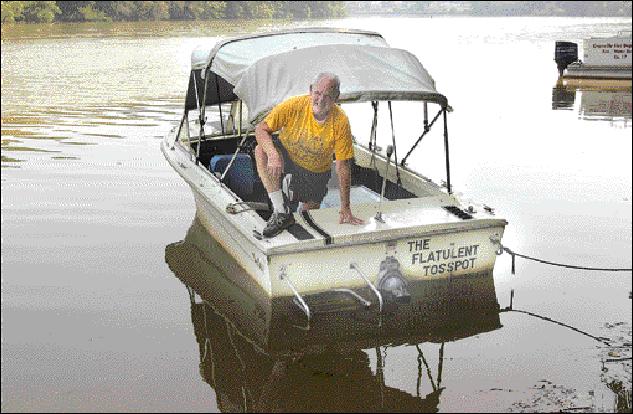
Ron Rittenhouse/The Dominion Post
A recreational boater for nearly 50 years, Granville resident Don Strimbeck serves as secretary and spokesperson for the Upper Mon River Association Inc. Concerned about the negative economic impact of reduced hours of operation at the Morgantown, Hildebrand and Opekiska locks and dams slated for implementation Oct.1, UMRA initiated an ongoing campaign in March 2000 to moderate the new lockage schedule.
They identify themselves collectively as "the Upper Monongahela River Association Inc." in correspondence with national, state and local elected officials and business leaders and with the commanding officer of the Pittsburgh District of the U.S. Army Corps of Engineers.
Bob Gay/The Dominion Post File Photo
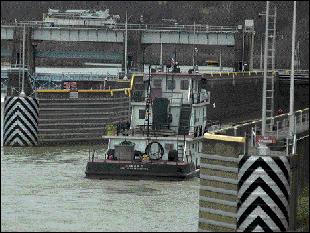
A tow boat slowly steers its way into the lock chamber of the
Morgantown Lock and Dam in this Jan. 25, 2002, file photo. Budget
cutbacks and a decline in commercial tonnage passing through the
facility have led Pittsburgh District of the Corps of Engineers
to reduce hours for commercial and recreational boaters on the
Upper Mon.
Boating on their home waters of the Upper Mon, however, the Morgantown area residents who make up the UMRA are simply recreational boaters -- "river rats" some call themselves.
Landlubbers from Fairmont to southwestern Pennsylvania's Ten Mile Creek frequently catch glimpses of them from the river's banks. They zip up and down the 65-mile Upper Mon in bass boats and inboards, make more stately passages in pontoon boats and the occasional sternwheeler, and silently slip along the rivers' banks in canoes and kayaks.
The scenic waterway they travel is formed by the convergence of the West Fork and Tygart rivers in Fairmont. The Mon flows north and merges with the Allegheny River at Pittsburgh to become the Ohio River. "Monongahela," incidentally, allegedly translates from an archaic American Indian language into English as "river with crumbling banks."
A shallow waterway in its natural state (early pioneers may have been able to walk across it), the Mon is navigable today due to a series of nine locks and dams located along its meandering 130-mile path.
The river's first locks were built in the 1840s on the Lower Mon in Pennsylvania to accommodate the waterway's burgeoning steamboat traffic. In 1904 the U.S. Army Corps of Engineers built five additional locks on the Upper Mon in West Virginia that were replaced after World War II by the locks and dams in use today. The COE completed construction of the Morgantown and Hildebrand facilities in 1959 and Opekiska in 1967.
The COE operated the Morgantown Lock and Dam year-round and around-the-clock for more than 50 years, transiting commercial and recreational vessels upstream into the six-mile-long Hildebrand pool to the south and downstream into the 12-mile-long Point Marion pool to the north.
Due to ongoing budget cutbacks and a drastic decline in recent years in commercial tonnage passing through the Morgantown facility's gates, the Pittsburgh District of the COE eliminated the lock-and-dam's midnight shift July 7, 2003. With the start of the federal 2004 fiscal year Oct. 1, 2003, the COE will further trim the Morgantown Lock and Dam's hours to 12:30-8:20 p.m. seven days a week from mid-May through mid-October, the traditional recreational boating season. Morgantown's schedule will shift to 8 a.m. to 4 p.m. for the remaining seven months of the year.
The Hildebrand and Opekiska facilities operated 24/7 until 1985 when commercial use plummeted and the Pittsburgh District of the COE reduced its hours of operation to day-shift only.
However, the Upper Mon's two southernmost locks will operate on an even more limited basis, according to a COE proposal dated March 25, 2003. Beginning Oct. 1, the Hildebrand and Opekiska locks and dams will operate 12:30-8:20 p.m. weekends and holidays only, mid-May through mid-October. The proposal calls for both facilities to be closed to navigation the remaining seven months of the year.
The proposal notes that "locks are operated for commercial vessels by appointment beyond the indicated hours," although "no appointment for lockage will be made between 2300 (11 p.m.) and 0630 (6:30 a.m.)" and "recreation vessels cannot lock by appointment."
Federal statute requires the COE to set lockage hours according to the tonnage of river commerce (such as barges loaded with coal, rock or metals) transiting a given lock annually. However those regulations prevent the COE from factoring into the formula the number of recreational vessels using the lock or the financial impact recreational boaters may have on a riverfront community's overall economy and development.
Don Strimbeck, secretary of the Upper Monongahela River Association and a Cheat Lake boater for nearly 50 years, has witnessed the decline in commercial tonnage on the Upper Mon from his riverfront home in Granville since 1994.
"The first year I lived in Granville, I noticed a good deal of tow traffic on the river," he recalled, "but within two years I saw a drastic decline in the number of coal-loaded barges passing my dock.
"By '97 the tow traffic seemed to have slowed to a trickle," Strimbeck said, adding that he surmised the decline in commercial traffic to be a by-product of the 1990 federal Clean Air Act Amendments that adversely affected the market for the predominantly high-sulfur coal mined in the Upper Mon region and shipped on the area's waterways.
COE lockage data support Strimbeck's observations and theory.
In 1987 Morgantown Lock and Dam reported record high commercial use of 2.9 million commercial tons, 81 percent of which was coal. Morgantown's lowest annual commercial use occurred in 1998 when less than 123 tons transited, 70 percent of which was coal.
Coal accounted for virtually 100 percent of the 1.6 million commercial tons that passed through Hildebrand Lock and Dam in 1987, the facility's year of highest commercial use. That tonnage shrank to a scant 13 tons by 1999 although coal still accounted for 81 percent of the total.
Opekiska experienced its record commercial year in 1989 when 361 tons (97 percent coal) passed through its facility's gates. By 1999 only 14 commercial tons transited the Monongahela's southernmost lock with coal still accounting for 97 percent of the freight.
Although Morgantown enjoyed a minor resurgence of commercial traffic in 2000 to approximately 300 tons, coal shipments made up only 8 percent of that commercial tonnage.
However, the COE data also indicate the number of recreational vessels transiting the Morgantown, Hildebrand and Opekiska locks increased dramatically from 1987 to 2000.
Five hundred three recreational vessels passed through the Morgantown locks in 1987: 736 transited the facility's gates in 2000.
Hildebrand's recreational traffic increased from 312 vessels in 1987 to 404 in 2000.
Five hundred fifty-one moved through Opekiska in 1987: By 2000 the lock's recreational vessel tally had risen to 832.
But these increases are moot according to current COE guidelines determining lockage service levels -- a situation that's mobilized Strimbeck and other Morgantown-area recreational boaters who make up the UMRA membership.
"The Pittsburgh District of the Corps of Engineers isn't the problem," Strimbeck said. "They're doing the best they can within regulatory and budgetary constraints to serve recreational boaters on the Upper Mon.
"The regulations themselves are the problem."
NEXT WEEK: The Upper Mon Water Trail defined, BIG (Boating
Infrastructure Grant) funds pending, and UMRA's Navigation
Resolution gains support.
judy reckart writes an employment feature each week for The
Dominion Post. You can reach her by e-mail at newsroom@dominionpost.com