Sunday Gazette-Mail
June 26, 2005
By John McCoy, Staff writer
WINFIELD - With a deft flick of his pool cue-thick fishing rod, an angler flings a cast over a hundred-foot maelstrom of churning white water. The bait hardly has a chance to settle before the stiff rod bends over.
"Got one!" the angler yells, setting the hook hard. Forty yards downstream, a 4-pound hybrid striped bass thrashes angrily on the river's swirling surface.
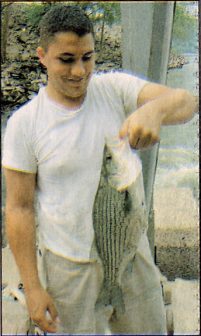 A 4-pound hybrid striped bass might seem like a trophy
to some, but to Winfield regular A.D. Brooks, it's merely
average. Tailwater fisheries routinely yield hybrids In the 7- to
9-pound class and flathead catfish in the 30- to 40-pound class.
A 4-pound hybrid striped bass might seem like a trophy
to some, but to Winfield regular A.D. Brooks, it's merely
average. Tailwater fisheries routinely yield hybrids In the 7- to
9-pound class and flathead catfish in the 30- to 40-pound class.
"When you throw your line in there, you're
liable to haul out just about anything."
Fisherman A.D. Brooks
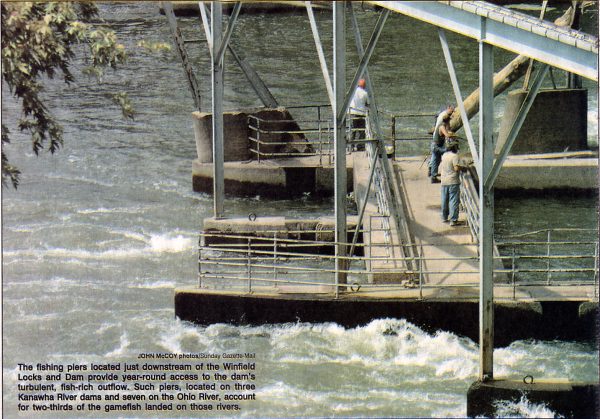
Welcome to one of West Virginia's most popular and productive fishing spots - the steel-and-concrete piers located just downstream of Putnam County's Winfield Locks and Dam. Those piers, along with two other sets along the Kanawha River and seven others on the Ohio, account for two-thirds of the gamefish caught in those waterways.
"They're very important fisheries," said Bret Preston, Division of Natural Resources' assistant chief in charge of warmwater fishing.
"They get a lot of fishing pressure, but they're so productive it doesn't seem to affect them."
The secret to the dams' productivity is the turbulent, oxygen-rich water that surges from their bases.
"The current makes the difference," said Zack Brown, district fisheries biologist for the state's southwestern counties.
"Shad and other baitfish gather into areas where there are strong currents. Where the baitfish are, the large predators go."
The dominant gamefish species varies by season.
"In March and April, most of the people who come to the piers will be fishing for walleyes or sauger," Brown said.
"A little later, white bass and hybrid striped bass get most of the attention. As the season progresses into the summer months, flathead catfish and channel cats are the targets."
Catch rates are high because the fish tend to "stack up" in the dams' oxygen-suffused outflows.
"When they're concentrated like that, they're a little more vulnerable to fishermen," Brown said.
One of the things fishermen enjoy most about the piers is the sheer variety of fish.
"When you throw your line in there, you're liable to haul out just about anything," said A.D. Brooks, a Winfield Locks regular.
"Today it's hybrids and flatheads. Tomorrow it could be smallmouths or white bass."
Though the mix varies some from dam to dam, most of the Ohio and Kanawha river fisheries contain smallmouth bass, spotted bass, white bass, hybrid striped bass, walleye, sauger, freshwater drum, channel catfish and flathead catfish.
Minor species can include skipjack herring, sunfish, paddlefish and the occasional muskellunge.
The piers were built because the U.S. Army Corps of Engineers has historically refused to allow boats to approach the dams' turbulent outflows. To make up for the lack of downriver access, DNR officials asked the Corps and the dams' hydropower providers to construct piers that would allow bank fishermen to stand directly over the highly productive tailwaters.
"A lot of those piers were built when the dams' hydro facilties came up for re-licensing under the Federal Energy Regulatory Commission," said the DNR's Preston. "As one of the conditions for getting their new licenses, we asked them to provide fishing access."
The piers have been wildly popular ever since. Some, like the one downstream of New Martinsville's Hannibal Locks, have special features such as fish-attracting structures and fish-cleaning facilities.
Others, such as those at Winfield and Marmet, have only the piers themselves.
Anglers like the piers for two principal reasons: They bring fish and fishermen close together, and it doesn't cost a cent to use them.
"It's real cheap to fish at these piers because you don't have to spend money on bait," said Matthew Buzzard of Scott Depot, another Winfield regular. "If you bring a net or a light spinning rod, you can catch all the bait you need in just a few minutes."
The only down side to the piers is that it takes a while to learn to fish them effectively.
"You need to learn where the subsurface rocks are located, and where the main velocity breaks in the currents are," said biologist Brown. "And you have to learn to use the right equipment. If you bring the same little spinning rig you use for smallmouth bass, you might end up losing a lot of line or even end up with a broken rod."
Tailwater fish can be surprisingly large, and in the swift currents they fight exceptionally hard. Angler Brooks said he routinely hooks fish that he can't handle, even on heavy bait-casting tackle.
"Just today, I hooked a flathead I couldn't budge on 40-pound-test line," he said.
"It ended up breaking off."
Unfortunate? Sure. But for the thousands of anglers who frequent West Virginia's tailwater fishing piers, it's simply part of the game.
To contact staff writer John McCoy, use e-mail or call 348-1231.